Bowing basement wall repair in Topeka runs $2,500–$10,000 depending on deflection and method — carbon fiber under about an inch, steel braces or wall anchors beyond that. The cause is shrink-swell clay ratcheting sideways against the wall through Kansas wet-dry cycles, with freeze-thaw pressure added each winter.
Here's how to read your wall, and which repair the measurement points to.
The ratchet: why the wall never gets a break
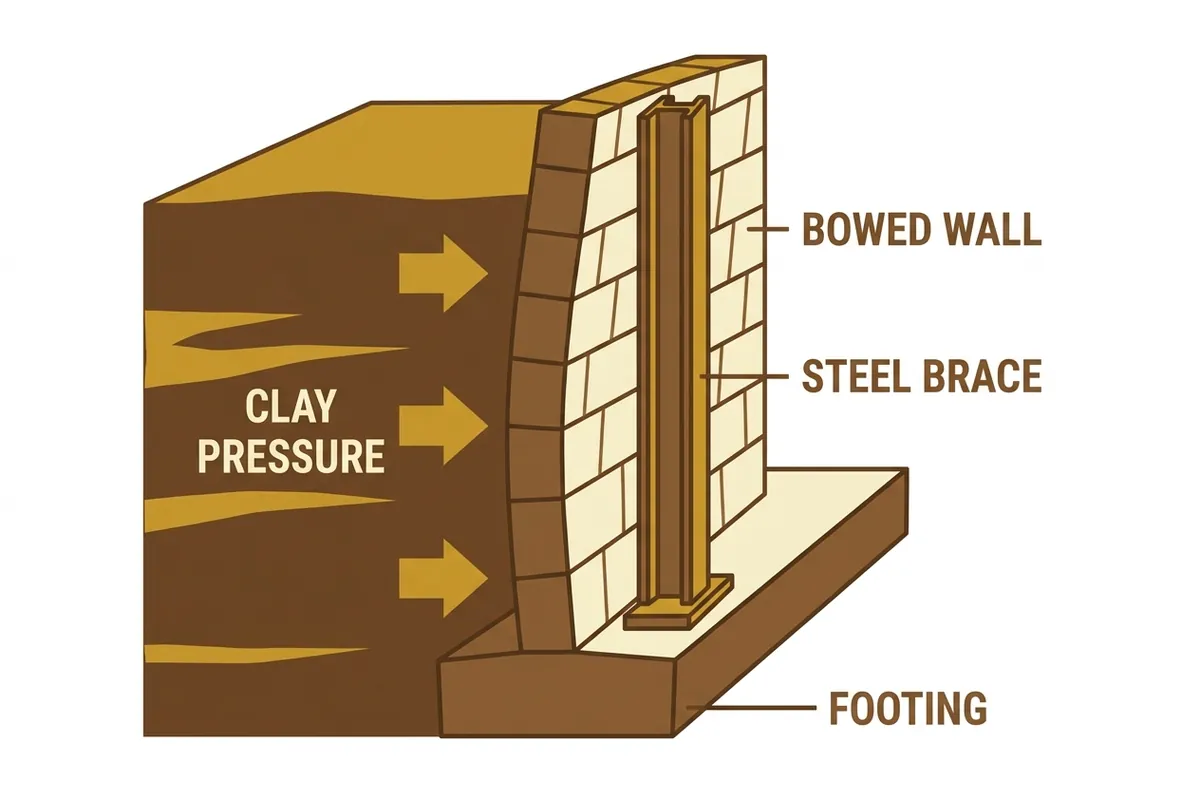
Ordinary soil pressure against a basement wall is a static load the wall was designed for. Kansas clay turns it into something else. Through a dry late summer the clay contracts and pulls back from the wall, opening a narrow gap along it. Loose soil, debris, and surface water settle into that gap — a small amount, but it doesn't leave.
Then the spring rains return and the clay swells back toward its original volume, except now part of that volume is occupied. Having nowhere else to expand, it presses into the wall. Each cycle gains a little ground, and the wall takes the difference. This is why Shawnee County basement walls accumulate deflection year over year rather than cracking once and stopping — and why the crack you noticed this spring is usually wider than the one you didn't notice last spring.
Kansas winters add the second load. Repeated freeze-thaw cycling drives frost into moist soil against the upper wall, and freezing water expands, pressing inward on a wall that's already carrying the ratchet.
Reading your own wall in five minutes
Drop a plumb line from the top of the wall to the floor, or hold a straightedge against it, and measure the largest gap. That number drives everything:
| Deflection | What it means | Typical repair | Range |
|---|---|---|---|
| Under 1 inch | Early, stable enough to plan around | Carbon fiber straps | $2,500–$5,000 |
| 1–2 inches | Established movement, load still active | Steel braces or wall anchors | $4,000–$8,000 |
| Over 2 inches, or shearing | Structural capacity compromised | Anchors with recovery, or rebuild | $8,000–$25,000+ |
Shearing — the wall sliding at the top where it meets the sill, or at the bottom where it meets the slab — changes the answer regardless of the deflection number.
The methods, and what each actually does
- Carbon fiber straps — bonded floor-to-sill on a prepared surface; resist further movement, add no thickness, don't straighten
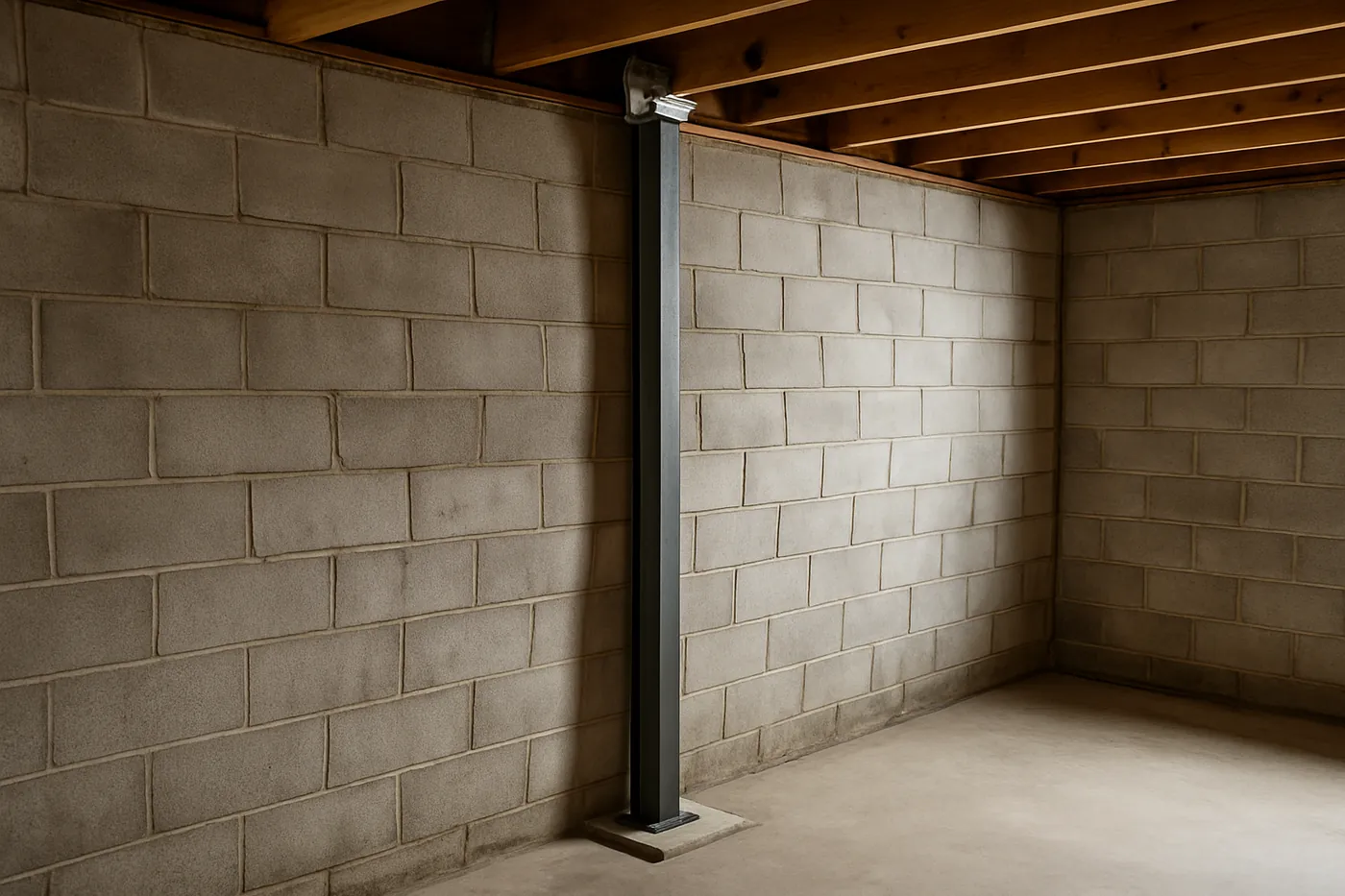
- Steel I-beam braces — anchored to the footing and floor joists; strong, and they occupy a few inches along the wall
- Wall anchors — plates set in the yard beyond the failure plane, tightened over months to recover deflection; need yard access
- Rebuild — the honest answer for sheared or deteriorated walls, and the one nobody enjoys quoting
Flatten the cycle and the restraint has an easier job
Restraint holds a wall against a load. Reduce the load and the same restraint holds with margin to spare — which is why our scopes price moisture management alongside the steel. Steady moisture at the foundation line means less contraction in August, which means a smaller gap for debris to fill and less ratcheting next spring. Downspout extensions, corrected grading, and where appropriate drainage at the wall are the cheapest structural work available in this market, and they appear first on our scopes for that reason.
Where a leaning wall sits in the foundation repair sequence
Wall restraint is the third step in a Topeka foundation repair, not the first. The order that holds on this soil runs: exterior water corrections (downspout extensions, restored grading — often a few hundred dollars, and they flatten the cycle), then drainage at the wall where the basement takes water, then the restraint itself against a smaller load, and cosmetic repair last once movement is provably finished.
Two exceptions move restraint to the front: deflection past roughly two inches, and any shearing at the top or bottom of the wall. Those are structural situations addressed on their own timeline. And where the floor survey also shows a settled footing, the piering is sequenced with the wall work so nothing gets installed twice. Your written scope names the order and prices each line separately, so you can stage it if you want to.
Bowing wall questions, straight answers
How much bowing is too much?
Deflection under an inch is generally repairable with carbon fiber and is a repair to schedule rather than rush. Between one and two inches, braces or anchors are usually specified. Past two inches, or with shearing where the wall meets the sill or the floor, the wall may need rebuilding — and that determination belongs to a measurement, not a glance.
Does carbon fiber actually work?
For walls within its deflection range, yes. Straps bonded to a properly prepared surface resist further inward movement and have essentially no thickness, so the basement stays usable. What carbon fiber doesn't do is straighten a wall or remove the clay pressure causing the bow — it holds the line where the line currently is.
Can a leaning wall be straightened?
Wall anchors and some brace systems can recover deflection gradually, tightened over months as soil pressure outside is relieved. Anchors need yard space beyond the wall to set the plates, which rules them out on tight lots. Recovery is realistic on some walls and not others, and we say which before you buy anything.
Why do so many Topeka basements have this problem?
Because this market combines two things: high shrink-swell clay and full basements almost everywhere. A slab house on the same soil shows settlement instead. Put a basement wall against clay that ratchets tighter each seasonal cycle, add Kansas freeze-thaw pressure on top, and inward deflection is the predictable outcome.
Is my house in danger of collapse?
Almost never suddenly, and not without warning signs a measurement catches first. Basement walls fail progressively over years. The reason to act isn't imminent collapse — it's that cost climbs steeply with deflection: carbon fiber on a three-quarter-inch bow is a small fraction of what rebuilding a sheared wall costs.
Get a free Topeka foundation evaluation
Tell us what the house is doing — a basement wall leaning in, stair-step cracks, doors that stick every August, sloping floors — and we’ll schedule an evaluation with photos, wall measurements, and floor elevations. We reply the same business day.