Basement waterproofing in Topeka runs $2,500–$8,000 for a full interior drainage system with a sealed sump, and exterior corrections often land under $500. Because shrink-swell clay damages foundations through moisture swings, steadying moisture at the foundation line is the cheapest structural work here.
Here's why water is half the foundation conversation on Kaw Valley clay.
Amplitude is the enemy, not water
Evenly moist soil is survivable. What damages Topeka foundations is the size of the swing and its unevenness — one side of the house soaked by downspouts through a wet spring while the other bakes through a Kansas August. The foundation spans that difference, and the structure racks. Against a basement wall, the same swing drives the ratchet that bows it inward.
That's why the evaluation walks the outside of your house as carefully as the inside: gutters and downspout terminations, the slope of the first ten feet of ground, mulch beds holding moisture against the wall, air conditioner condensate, large trees drinking hundreds of gallons on hot weeks, and where the neighboring lot drains. Those findings frequently explain the crack pattern better than the crack does.
The ladder, cheapest first
- Downspout extensions — carry roof water six feet or more from the wall; often under $500 and frequently decisive
- Regrading — restore fall away from the foundation where decades of settling reversed it
- Swales and surface routing — intercept runoff crossing the lot before it reaches the house
- Interior drainage and a sealed sump — where a basement takes water at the cove joint, tile bedded at the footing carries it to a basin and out
- Consistent dry-season watering — a soaker hose on a timer during extended drought, to flatten the shrink half of the cycle
The loess caveat nobody mentions
Everything above assumes moderation, and over loess that assumption carries real weight. Loess is metastable: it stands up well dry and can lose structure when thoroughly saturated. So the advice to keep foundation soil evenly moist means evenly — a soaker hose on a timer, not a sprinkler running against the house, and never a drain line discharging into the same spot for years. Concentrated saturation is one of the few ways to cause sudden settlement in this region, and it's entirely preventable.
What we won't sell you
A drain system where extensions would do. If four downspout extensions and a regrade solve your problem, that's what the written scope says, at that price — and every subsurface line we scope gets walked to its discharge point before it's quoted, because a drain that terminates too close to the house just relocates the problem.
Where waterproofing ends and foundation repair begins
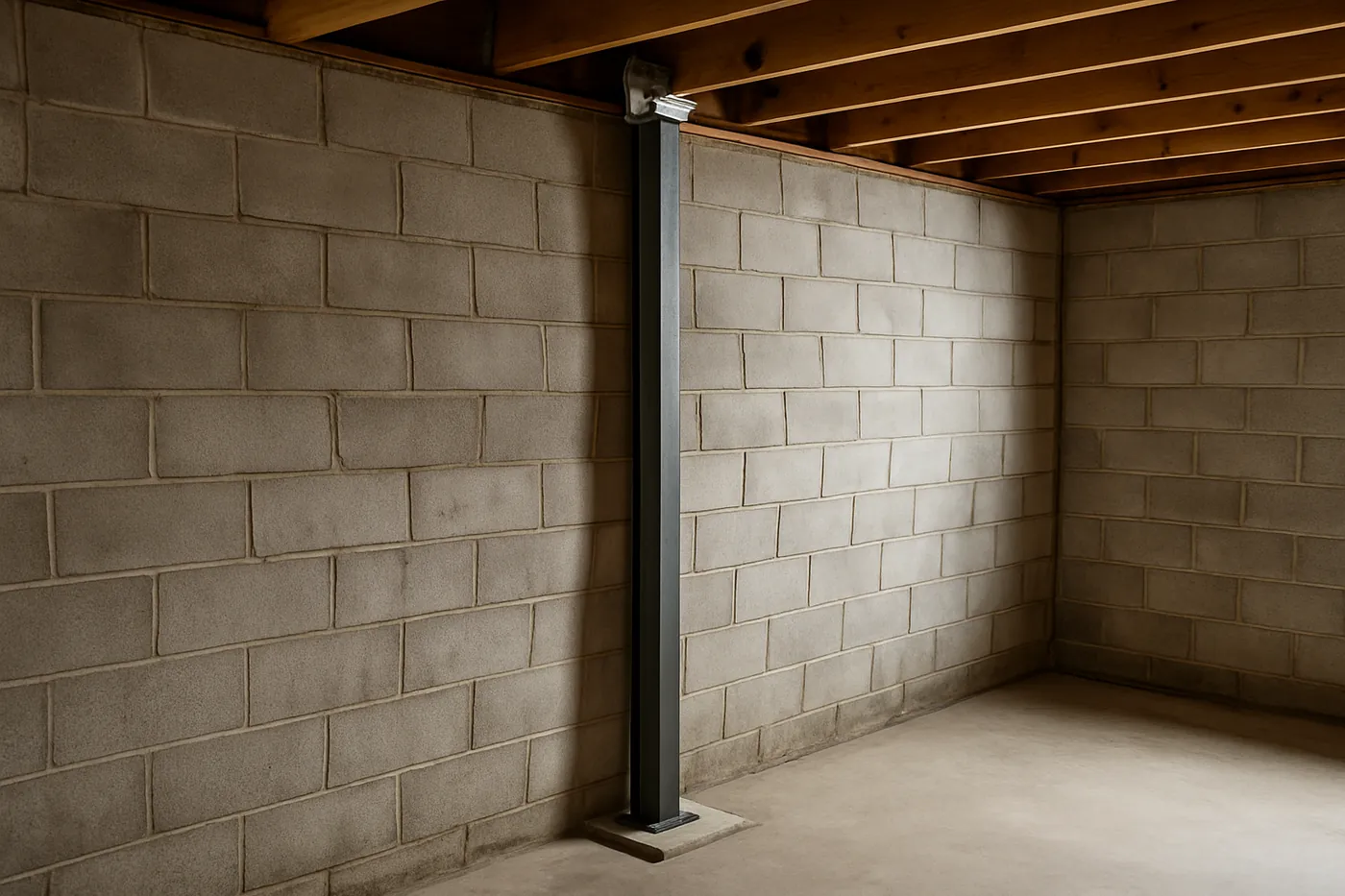
The line is structural damage. Managing water is the right and complete answer for a basement that takes some water but whose walls read plumb and whose floors read level — and that describes a lot of Shawnee County houses. Once the moisture cycle has done structural work, though, you're into foundation repair proper: a wall the clay has ratcheted inward needs restraint, and a footing that lost bearing needs piers.
Both get measured on the same free visit, because it is the same visit — a plumb line on each basement wall and a laser across the floor take a few minutes and settle which side of that line your house is on. What you shouldn't do is buy structural work without addressing the water that drives the cycle, or assume drainage alone straightens a wall that has already moved.
Outside the wall or inside it?
Every Topeka basement is a wall holding back the Kansas River valley's clay, and that clay swells with the wet springs and lets go in the dry late summers. Water is one problem; what the water does to the clay is the second.
| Option | What it does | Why it matters in this metro |
|---|---|---|
| Exterior excavation | Membrane and drainage applied at the wall itself | Best where the wall already needs excavation for structural work — do both at once |
| Interior drain and sump | Water managed at the footing from inside | The standard answer for spring water arriving at the footing |
| Crack injection | Seals one specific leak path in a poured wall | Right for a single weeping crack in poured concrete, once movement is ruled out |
| Grading and gutters | Keeps the largest source off the wall for the least money | The highest-value first dollar — most spring water starts at the downspouts |
Watch the walls, not just the floor. In this metro the wall that leaks is often also the wall the clay is pushing, and waterproofing a bowing wall answers the wrong question first.
Waterproofing questions, straight answers
What does basement waterproofing cost in Topeka?
A full interior drainage system with a sealed sump typically runs $2,500 to $8,000, set mostly by linear feet of wall and whether the sump and discharge need replacing. Partial systems on one wet wall land lower, and exterior corrections — downspouts and grading — often solve the problem outright for a few hundred dollars.
Isn't Kansas too dry for this to matter?
Roughly 36 inches a year sounds moderate, but it arrives unevenly, and the wet spring is exactly when clay swells hardest against a basement wall. Waterproofing here isn't about a high water table the way it is in wetter regions — it's about steadying the moisture cycle that drives the ratchet.
Will this stop the musty smell too?
Usually, because the smell is evaporating moisture. Once water is intercepted at the footing and discharged instead of sitting in block cores and the slab edge, humidity drops and the odor goes with it. Basements that stay damp afterward generally need a dehumidifier sized for the space, which is a much smaller line item.
Should I water my foundation in a Kansas drought?
Consistent moderate moisture at the drip line during extended dry spells reduces the shrink half of the cycle — a soaker hose on a timer, not a flood. It's mitigation, not repair. And over loess, overdoing it is genuinely counterproductive: saturating that soil can cause the collapse you were trying to avoid.
Get a free Topeka foundation evaluation
Tell us what the house is doing — a basement wall leaning in, stair-step cracks, doors that stick every August, sloping floors — and we’ll schedule an evaluation with photos, wall measurements, and floor elevations. We reply the same business day.